

.
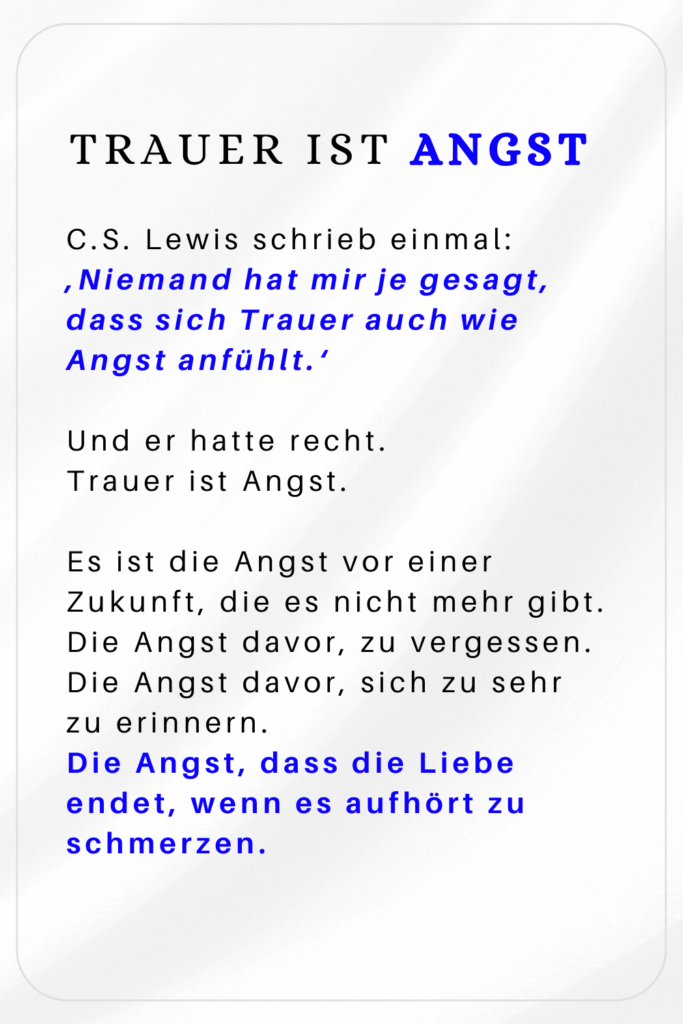
Do you know the feeling when grief feels not only like deep sadness, but also like a huge wave of fear? C.S. Lewis put it aptly:
No one ever told me that grief feels like fear.
When my father died, I experienced just that:
Suddenly, grief was no longer a silent cry, but an incessant rush of heart in the middle of the night, accompanied by the panic of forgetting his voice – and the fear of feeling nothing at all at some point.
Last week a reader wrote to me: "Sometimes I’m afraid to live on – as if I’m betraying him." And I could understand her so well! Grief is not a straight path, but a wild dance between remembering and letting go, between pain and the fear of losing that pain at some point.
But why are grief and fear so closely linked?
Suddenly a huge hole in your plans gaps. The person you wanted to celebrate Christmas with is no longer there, and the future feels like a puzzle missing important pieces.
"What if I can’t remember the sound of his laughter?"
This question haunted me day after day. I started storing voice messages and hoarding photos – as if I could stop time with it. A friend said,
I don’t dare to delete old messages. It’s like losing him a second time.
Grief cannot be put in drawers. It’s chaotic, unpredictable and sometimes just damn scary.
"Is it normal to feel fear in grief?"
Absolutely! Grief is a wild mix of emotions – fear, anger, powerlessness. If your heart is racing or you have sleep problems, you are not alone.
"How can I overcome the fear of forgetting?"
Write letters, keep a journal, or set up a small memory corner. Collect memorabilia such as perfume, aftershave or deodorant on a cloth. Tell him or her about your day as if the person was still there. So fear shrinks when you actively preserve memories.
"Why am I afraid to let go of the pain?"
Pain is often the last bond of love. But don’t worry: you won’t stop loving just because you smile again – love is changing.
"Can fear in grief be physical?"
Yes! My back was tense for months until my therapist said, "Grief sits in the body like a frozen scream." Exercise, breathing exercises and relaxation techniques can work wonders.
You don't always have to be strong. A day in pajamas with old photos is just as valuable as a "productive" day.
I wrote a letter to my fear:
You want to protect me, I know. But let me breathe.
Sounds cheesy? Maybe. But sometimes it is precisely this direct dialogue with one’s own fear that is the first step towards liberation.
A mourner once told me:
I don’t want to be healed. I want to learn to dance with the hole in my soul.
Accept change – peace begins with accepting one’s own emotions.
You are not alone – together through pain
Grief can make us feel like strangers in our own bodies. But you are not broken, not wrong and, above all, not alone. As C.S. Lewis put it, grief is fear – but that fear can also be a guide to how deep your love went.
Grief and fear are closely linked, as both feelings are triggered by changes with insecurities. Both show up in physical symptoms such as heart racing and sleep disturbances.
Perceiving fear and actively remembering is key: write letters, collect memorabilia, share stories. Useful sensory memories: Scents, music or photos can help keep memories alive. Accept that memories change: it is not about keeping everything perfect, but honoring love and connection.
Yes, absolutely. Grief is a complex mixture of feelings, and fear is a common companion. It is normal to be afraid of the future, the loss of security and dealing with the pain.
Also accept this fear: it is a natural reaction to the situation of expected loss and also part of the grief process. Every moment in your life has the potential to become a memory. Create memories, record them as a picture or video, maybe keep a diary by recording your experiences. Seek support: Talk to friends, family, or a therapist. Find ways to deal with anxiety: Breathing exercises, meditation, or yoga can help.
Recognize and accept both feelings: they are connected.
Take care of yourself: Pay attention to adequate sleep, healthy diet and exercise. Seek professional help: A companion or therapist:in can help you deal with both feelings.
Fear of the future is a normal part of the grief process.
It helps to set small realistic goals. It is important to give yourself time and accept that the future will look different than expected.
Physical symptoms of anxiety in grief can include heart racing, shortness of breath, muscle tension, sleep disorders and gastrointestinal problems.
Breathing exercises, yoga, and relaxation techniques can help relieve these symptoms.
If the symptoms become too severe, it is advisable to consult a doctor.
Professional therapy: A grief companion:in or therapist:in can work with you to develop individual strategies for managing grief and anxiety.
Self-help groups: Exchange with other stakeholders can be relieving.
Mindfulness exercises: They can help stay in the present moment and reduce fears. There are many organizations that specialize in grief care – Trauer Taskforce

